5 - Liquidity
5.1 - Liquidity Definition
- Liquidity is the fuel of the market.
- Liquidity pools are zones where lots of orders are assumed to be stacked together.
- The price action moves towards liquidity pools to grab new orders before charging up for the next move.
- The market will either pursue liquidity or rectify inefficiencies.
5.2 - Liquidity Pool Types
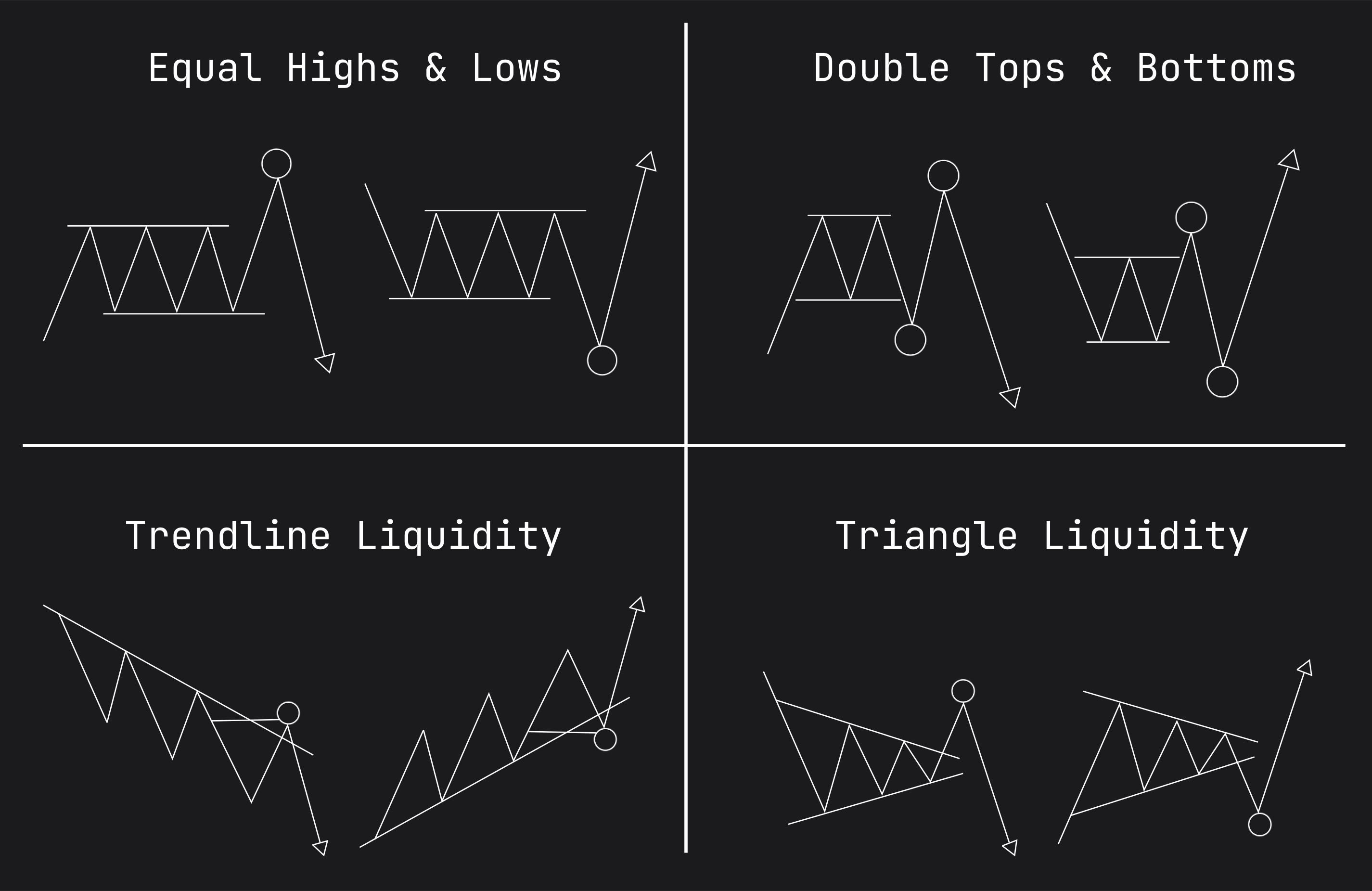
- Liquidity behind trend lines.
- Liquidity behind major swing pivots.
- Liquidity above and below a range.
- Liquidity behind symmetrical triangle patterns.
- Liquidity behind equal lows or equal highs.
- Liquidity behind double tops or double bottoms.
- Liquidity behind the highs and lows that are formed within a Fair Value Gap (FVG).
5.3 - Liquidity Grab (LG)
Liquidity Grab (LG) refers to a price action where the market moves rapidly beyond a key level (like a previous high or low) and then reverses. This phenomenon is often described as "Smart Money" deliberately targeting stop-loss orders or pending breakout orders clustered at these levels, which are assumed to be "liquidity pools."
Important Consideration: Myth vs. Reality While the term "liquidity grab" describes a real observed price pattern, the common narrative that it's primarily a deliberate strategy by institutions to hunt retail stops at dense "liquidity pools" (especially at major swing highs/lows) is debated. Significant swing points are often liquidity voids rather than pools. Rapid movements through these levels can signify market inefficiency (a lack of opposing orders to slow the price) rather than a deliberate "grab." Institutional activity is more focused on efficient execution of large orders by seeking deep genuine liquidity, rather than targeting retail stops. You can read more about this in our Trading Myths guide, located in the academy's appendices.
Valid liquidity grabs must satisfy the following conditions:
- The price action must reverse after the liquidity sweep.
- You should observe displacement in the price action in the opposite direction of the sweep. This displacement should also break the market structure.
- The displacement in the price action must leave behind a fair value gap (FVG).
- Strong liquidity grabs or sweeps are those that take out the highest/lowest wick at a key level with only a wick before reversing.
- The likelihood of experiencing a reversal or pullback subsequent to a liquidity grab becomes more pronounced when accompanied by a surge or spike in trading volume.
- Generally speaking, you have to analyze the order flow and market structure to determine if a certain move is merely for taking out liquidity or if it is a valid Change of Character (CHoCH) as well.
Your chapter on External Range Liquidity (ERL) and Internal Range Liquidity (IRL) is well-structured and provides a good introduction to these specialized types of liquidity. However, there are some areas where the content could be enhanced for clarity, depth, and accuracy. Below is a revised version of your chapter with corrections and improvements.
5.4 - Market Structure Shift (MSS) versus Liquidity Grab (LG)
It's crucial for traders to distinguish between a Market Structure Shift (MSS) and a Liquidity Grab (LG) as they have different implications for market behavior. Below we clarify the distinctions:
5.4.1 - Market Structure Shift (MSS)
- Definition: MSS is characterized by a significant change in the price direction, confirmed by multiple candlestick bodies closing beyond a key level.
- Market Impact: This shift often creates an imbalance in the price leg that has broken the structure, indicating a stronger move and potential trend formation.
5.4.2 - Liquidity Grab (LG)
- Definition: LG occurs when there's a brief and sharp move beyond a key level, typically after a sweep in the opposite direction of the impending break.
- Market Impact: The break is often signified by a wick rather than a full candle body close, suggesting a false breakout intended to trigger stop-loss orders before the price moves in the opposite direction.
5.5 - External Range Liquidity (ERL) & Internal Range Liquidity (IRL)
Liquidity in trading refers to the ease with which assets can be bought or sold in the market without causing a significant impact on the asset's price. A liquid market is characterized by a high availability of buyers and sellers. In this context, two specialized types of liquidity that traders should be aware of are External Range Liquidity (ERL) and Internal Range Liquidity (IRL).
5.5.1 - External Range Liquidity (ERL)
5.5.1.1 - Definition
External Range Liquidity (ERL) refers to the liquidity that is concentrated around previous swing highs and lows. These points often serve as psychological levels where traders place stop orders or pending orders, thereby creating pools of liquidity.
5.5.1.2 - Importance
ERL serves as a magnet for price action, especially when it aligns with institutional order flow. For instance, if there is significant ERL at a previous low and the institutional order flow is bearish, the price is more likely to move towards that ERL level.
5.5.1.3 - How to Measure
- Identify Swing Highs and Lows: The first step is to identify recent swing highs and lows on the chart for your specific timeframe. These points will define your trading range.
- Order Book Analysis: Examine the order book to identify clusters of stop orders or pending orders at these swing highs and lows. This will give you an idea of where the ERL exists.
- Institutional Order Flow: Monitor news, reports, and other data sources to gauge the direction of institutional order flow. This can provide insights into which ERL levels are likely to be targeted.
5.5.1.4 - Practical Tips
- Monitor Institutional Flow: Keep an eye on institutional order flow to understand which ERL levels are likely to act as magnets for price action. If the flow is bearish, focus on ERL levels at previous lows.
- Strategic Positioning: Use ERL levels to set more distant profit targets or stop-loss levels. Since ERL can act as a magnet for price, positioning your orders around these levels can be advantageous.
5.5.2 - Internal Range Liquidity (IRL)
5.5.2.1 - Definition
Internal Range Liquidity (IRL) refers to the liquidity that exists within the trading range defined by the External Range Liquidity (ERL). This internal liquidity can manifest in various forms such as order blocks, fair value gaps, volume imbalances, mitigation blocks, and breakers.
5.5.2.2 - Importance
IRL is crucial for identifying actionable entry and exit points within the current trading range. These points, often influenced by institutional activity, can offer high-probability trade setups.
5.5.2.3 - How to Measure
- Identify Institutional Reference Points: Within the defined range, look for order blocks, fair value gaps, volume imbalances, mitigation blocks, and breakers. These are your IRL points.
- Volume Analysis: Use volume metrics like Volume Profile to confirm the significance of these IRL points. High volume areas often indicate strong levels of interest.
- Correlation with ERL: Assess how IRL levels interact with ERL levels. This can help you anticipate potential price movements and adjust your trading strategy accordingly.
5.5.2.4 - Practical Tips
- Immediate Trading Decisions: Use IRL for quick entries and exits, especially for intraday trading.
- Context Matters: Always consider the broader market context, including macroeconomic factors and news events, when evaluating how IRL interacts with ERL levels.
5.6 - Liquidity Sweeps vs. Liquidity Runs
Liquidity Sweep = Liquidity Grab = Fake-out Liquidity Run = Displacement / Expansion that continues after taking liquidity
- BoS (Break of Structure): the initial candle(s) that violate an old high/low.
- ChoCH / MSS (Change of Character / Market Structure Shift): the first swing break opposite the prior trend, confirming a reversal.
This section helps analyze whether a break of a key level is likely to reverse (Sweep) or continue (Run) using price action, Fair Value Gaps (FVGs), and structure labels. It's important to note that the initial move past a key level (often a previous high/low) might be an interaction with a liquidity void (a lack of orders) rather than a deliberate sweep of a dense liquidity pool.
1. Core Concepts
- Liquidity Sweep (Fake-out): Price moves rapidly beyond a significant level (often a previous high/low, which can be a liquidity void rather than a pool). This rapid movement can be due to a lack of opposing orders (market inefficiency) rather than a deliberate "grab." The price then rejects the level and reverses. This action can, however, trigger stop-losses and pending orders, contributing to the reversal.
- Liquidity Run (True Breakout): Price violates the level (BoS) and keeps expanding in the same direction. The run is the displacement that follows the BoS.
The difference is intent and follow-through—reversal vs. continuation.
2. How to Tell Them Apart
Focus on the character of the break and the reaction immediately after.
A. Liquidity Sweep → High-probability Reversal
- Hesitant Break: Long upper (or lower) wick(s), small real bodies closing only marginally beyond the level.
- Imbalance Context:
- A sweep may print an FVG, but it is often shallow or quickly violated.
- The significant FVG appears during the reversal leg in the opposite direction.
- Aggressive Reject & ChoCH/MSS: Price snaps back through the level and breaks the swing that delivered the sweep—your change of character.
- Entry Logic: Short/long from the opposing FVG created by the reversal, targeting a return to the range or opposing liquidity.
B. Liquidity Run → High-probability Continuation
- Decisive Break (BoS): Large-bodied candle(s) close well beyond the level with little or no upper wick (for bullish runs).
- FVG on Break: The displacement leaves a clear, unfilled FVG; price respects it on any pullback.
- Acceptance: Multiple candles hold above/below the level instead of snapping back.
- Continuation Structure: After a shallow pullback into the FVG or an order block, price prints higher highs (or lower lows) in line with the run.
3. The FVG Checklist (Weighted, not Binary)
Ask when price pierces a key high/low:
-
Did the displacement leave a clean FVG that price respects on retest?
- Adds weight to continuation.
-
Is there no clear FVG or does price immediately close through it?
- Adds weight to reversal.
Use this as a probability boost—not a guarantee—because some markets print FVGs on nearly every candle.
4. Confluence Boosters
Combine structure and FVG cues with:
- Higher-Time-Frame Trend: Moves counter to the HTF bias are more likely to be sweeps.
- Volume/Tick-Volume: Expanding on the break and steady on pullback supports a run; volume spike followed by shrinkage favors a sweep.
- Session Timing: London & New York opens provide the most reliable liquidity events.
- Order Blocks: An FVG nested inside a validated order block (one that price has not closed through) strengthens the level.
- Sweep + reversal FVG + ChoCH = high-probability fade.
- Strong BoS + breakout FVG respected on pullback = high-probability trend continuation.